
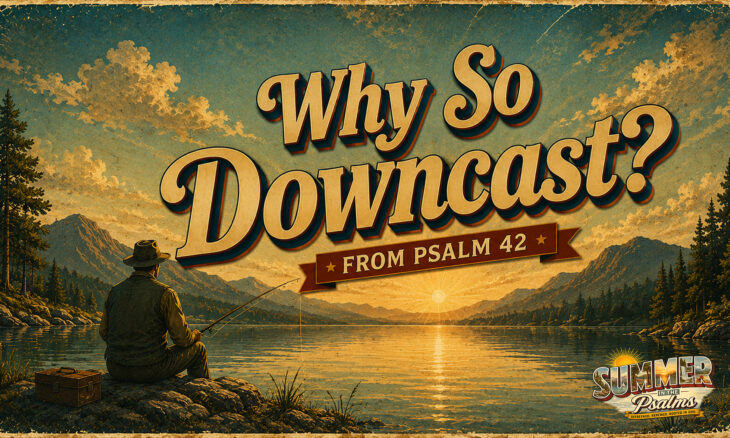
We all know the feeling even if we never say it out loud: the flat gray stretch where God feels distant, prayer feels like talking to the ceiling, and worship you used to love feels like going through the motions.
And yet this is another example of a text written by a worship leader. The Sons of Korah led God’s people in song at the temple, and one of them wrote the anthem of spiritual depression.
In truth, dryness isn’t a sign you’re not spiritual enough.
Two psalms, one song 42 and 43 share a refrain and belong together.
In the refrain, the whole thing ties together: three times, in the pit, he does something most of us never think to do. He talks back to his own soul.
The questions this song puts in front of us:
- What do I do when God feels far and worship runs dry?
- How do I fight despair without faking a joy I don’t feel?
Let’s jump into it!
Psalm 42:1–4
As a deer pants for flowing streams,
so pants my soul for you, O God.
2 My soul thirsts for God,
for the living God.
When shall I come and appear before God?[b]
3 My tears have been my food
day and night,
while they say to me all the day long,
“Where is your God?”
4 These things I remember,
as I pour out my soul:
how I would go with the throng
and lead them in procession to the house of God
with glad shouts and songs of praise,
a multitude keeping festival.
I. A Honest Thirst
A: What is spiritual thirst “As a deer pants for flowing streams” (v. 1)
Thirst isn’t a flaw in the soul; it’s the design. The deer isn’t broken for being thirsty — it was built to run on water.
- We were built to run on God. The emptiness you feel isn’t a malfunction; it’s the fuel gauge working.
- The Hebrew for “pants” (arag) is rare it shows up only here and in Joel, where the animals cry out in a drought. It’s not a sip; it’s a strain.
- Augustine said it plainly: God made us for Himself, and the heart stays restless until it rests in Him.
Spiritual thirst is the God-shaped craving underneath every other craving — the soul telling you what it actually runs on.
- You don’t get angry at the dashboard light for coming on; it’s doing its job.
- The sense of dryness is that light. The mistake is smashing the light instead of finding the stream.
Interestingly enough, often when humans crave food or sweets, the real thing that they’re needing is water; their body is dehydrated, but our brains are not always good at determining exactly what is required.
- It works that way spiritually as well. Many times we think what we need is the next thing when really what we need is the Lord
- Before you attempt to fix the feeling, think about it for a moment. Not just “why am I restless?” but “what is this restlessness for?”
B. Lets get practical — (v2)“My soul thirsts for God, for the living God”
Jeremiah 2:13
for my people have committed two evils:
they have forsaken me,
the fountain of living waters,
and hewed out cisterns for themselves,
broken cisterns that can hold no water.
The problem is rarely that we don’t thirst — it’s that we head to the wrong well.
Jeremiah names both sins in one breath: we forsake the fountain of living water, then dig our own cracked cisterns that can’t hold a drop.
- Broken cisterns today look ordinary one more scroll, one more purchase, one more win, one more helping, one more hit of approval.
- Dehydration disguises itself as hunger; that’s why a thirsty body reaches for food.
- A thirsty soul does the same, reaching for everything but God.
- Notice he says the living God because dead things can’t pour. An idol will take your worship and give you nothing back.
Out World says: you’re thirsty because you don’t have enough yet — get more.
Jesus says: whoever drinks the water I give will never thirst again (John 4).
- Misdirected thirst may be the most respectable sin in the room — it looks like ambition, like appetite, like just needing a break.
Name your cistern. What do you run to first when the ache shows up? That’s usually where you’ve been trying to draw water God never put.
C Spiritual dryness shapes us day to day“My tears have been my food day and night” (v. 3)
A dry soul has a short fuse. The thirst leaks out as irritability with people who didn’t cause it.
- The things that used to bring joy go flat which is exactly why the memory of old worship (v. 4) stings instead of soothes.
- Dryness runs us toward noise.
- We fill the quiet because the quiet is where we’d have to feel the thirst.
- Day and night the ache keeps no office hours. It shows up at 2 in the afternoon in the meeting and 2 in the morning in the dark.
Left unread, thirst just makes us tired and brittle. Read rightly, that same thirst becomes the thing that walks us to the water.
- Livestock in a drought will follow the smell of water for miles.
- Thirst isn’t only the problem; it’s the compass.
- The ache wrecking your Tuesday is also the thing pointing you home.
Don’t numb the thirst follow it. This week, treat the dryness as an appointment, not an interruption: it’s your soul asking to be brought to God.
Psalms 42:5
Why are you cast down, O my soul,
and why are you in turmoil within me?
Hope in God; for I shall again praise him,
my salvation and my God.
II. Preach to Your Heart…. Don’t Just Listen to It
Something shifts at verse 5.
- For four verses he’s been feeling panting, weeping, remembering.
- Now, mid-song, he does something different: he turns around and talks back.
He splits himself in two in a sense. There’s the soul that’s sunk down and there’s the man now standing over it, asking it a question.
Strange as it sounds, that split is the healthiest thing he does in the whole psalm.
There are two Hebrew words that lay out the contrast.
- Cast down (shachach) is the sink the collapse, the bowing low.
- In turmoil (hamah) is the churn the same word used for a roaring sea.
Depression is often both at once: caved in and stirred up. (Hold onto that roaring word — it comes back when the waves hit in v. 7.)
Everyone has an inner dialogue running. The question is never whether your heart is talking — it’s whether you’re listening to it or answering it.
A: Stop listening. Start talking.
Much of life’s misery comes from listening to ourselves instead of talking to ourselves. (This is exactly the psalm Martyn Lloyd-Jones built that line on — worth the attribution if you want it in the room.)
Your heart hands you a running commentary all day long:
- It’s hopeless.
- God’s forgotten you.
- It’ll always be like this.
- It’s all your fault.
- You’ll never live this down.
The psalmist stops swallowing that commentary and starts preaching truth back at it.
The prosecutor……
On a bad day your heart is a prosecuting attorney.
B: Your feelings are real but they don’t get the last word.
- Feelings are real data; they are not the verdict.
- They can and should be addressed — named, answered, brought into the light.
- You are not required to believe everything you feel.
He isn’t stuffing the feelings down. He’s refusing to let them run the show.
C: Notice what he preaches a Person, not a pep talk.
It’s not “cheer up.” It’s not “look on the bright side.” He doesn’t quote himself a chapter of positive thinking.
- He preaches two words: hope in God.
- The cure for a sinking soul isn’t better self-talk in general
- it’s a
The Hebrew for hope (yachal) isn’t wishing; it’s expectant waiting on Someone.
And catch the word again “I shall again praise Him.” This is a season, not a sentence. He isn’t there yet, but he’s telling his soul the winter will break.
D: This is not pretending and not a substitute for help.
- Sometimes the heaviness is grief.
- Sometimes it’s the body.
- Sometimes it’s a chemistry that needs a doctor.
God gives His people counselors, physicians, medicine, and each other as means of His grace.
Talking to your heart and reaching for help are not rivals do both.
But a life curved entirely in on itself will run dry.
If you are the only subject your heart ever preaches about, of course you’re sinking — you were never meant to be enough to hold up a whole life, and down deep your heart already knows it.
Turning to God isn’t just relief; it’s rescue from a soul that’s been feeding on itself.
And yet preaching to your heart doesn’t always make the sea go still. Sometimes you say “hope in God” and the next wave is already coming in. That’s exactly where he goes next.
Psalms 42:6–11
My soul is cast down within me;
therefore I remember you
from the land of Jordan and of Hermon,
from Mount Mizar.
7 Deep calls to deep
at the roar of your waterfalls;
all your breakers and your waves
have gone over me.
8 By day the Lord commands his steadfast love,
and at night his song is with me,
a prayer to the God of my life.
9 I say to God, my rock:
“Why have you forgotten me?
Why do I go mourning
because of the oppression of the enemy?”
10 As with a deadly wound in my bones,
my adversaries taunt me,
while they say to me all the day long,
“Where is your God?”
11 Why are you cast down, O my soul,
and why are you in turmoil within me?
Hope in God; for I shall again praise him,
my salvation and my God.
III. When Deep Calls to Deep
Remember the churning word from verse 5: the roaring, restless sea in his chest? Now it’s not a metaphor anymore. The waters feel real and they’re over his head.
In verse 6 he says he remembers God “from the land of Jordan and of Hermon, from Mount Mizar.” That’s the far north of Israel, up around the headwaters where the Jordan comes down off Mount Hermon
- Likely the crashing water in verse 7 isn’t just poetry,
- It’s plausibly the landscape he’s actually looking at.
Picture yourself there by the Jordan headwaters, under Mount Hermon, standing near the falls where the water crashes down cliff after cliff.
He’s watching one deep call to another and hearing his own life in the sound.
Deep calls to deep.
That’s the honest math of a hard season: sometimes it doesn’t arrive one trouble at a time.
One deep calls out and another answers.
- Grief calls to fear,
- fear calls to exhaustion,
- the next wave is breaking before you’ve caught your breath from the last.
Notice whose waves they are: “your breakers, your waves.” He isn’t sure he’s been abandoned by God; he’s sure he’s being carried through something God is somehow over.
That’s harder and better than blaming chance.
Jonah prayed this exact line from the belly of the fish.
- When you’re going under, you are in deep and ancient company
- The water has closed over God’s people before, and it didn’t get the last word.
The temple in Jerusalem was to the south; verse 4 aches over being cut off from leading worship there, and here he is up north by Hermon instead.
- It might be that for some reason he was displaced
- whether by exile, illness, or some circumstance keeping him from the sanctuary
And then, verse 8
Right in the middle of the flood he says: by day the Lord commands His steadfast love, and at night His song is with me.
The waves haven’t stopped. But something else is now sounding over them not just the roar of the water, but a song.
- Chesed— that “steadfast love” — is covenant love that doesn’t move with the tide.
- By day it’s commanded, holding steady whether he feels it or not.
- By night, when the water always sounds louder, there’s a song.
He went from being swept under to being sung over.
The deep is still roaring. But it’s no longer the only voice in the dark.
Psalm 43:1–4
Vindicate me, O God, and defend my cause
against an ungodly people,
from the deceitful and unjust man
deliver me!
2 For you are the God in whom I take refuge;
why have you rejected me?
Why do I go about mourning
because of the oppression of the enemy?
3 Send out your light and your truth;
let them lead me;
let them bring me to your holy hill
and to your dwelling!
4 Then I will go to the altar of God,
to God my exceeding joy,
and I will praise you with the lyre,
O God, my God.
IV. Send Out Your Light and Truth
Send out your light and your truth; let them lead me; let them bring me to your holy hill and to your dwelling! (v. 3)
Then I will go to the altar of God, to God my exceeding joy. (v. 4)
For a whole psalm and a half he’s been talking to his soul – “hope in God.” Now, finally, he turns and talks to God directly: “Send out your light and your truth.”
He’s not asking for.
- An explanation
- or “change my circumstances,”
- or “get rid of these people.”
He asks God to send something that will move him light and truth that will lead him, bring him, walk him back to the altar.
This is prayer with a destination. He’s not asking to feel better where he is; he’s asking to be led home.
A: This is a prayer for guidance, not just relief.
Light and truth aren’t abstractions here they’re a rescue party. “Send them out, let them lead me, let them bring me.”
That’s the language of two guides sent to walk a lost man back.
Light is what you need when you can’t see the way; truth is what you need when you can’t trust the way.
Dryness attacks both it blinds you to where God is, and it lies to you about who God is.
- So he doesn’t pray for a feeling; he prays for footing.
- Not a “make the ache stop,” but “get me moving in the right direction again.”
Which is deeply practical: when you’re in the dark, the prayer isn’t “God, fix how I feel.” It’s “God, send me enough light for the next step, and enough truth to trust You for it.”
B: The light leads not to answers, but to worship.
He doesn’t say “let them bring me to the answer” or “to the exit.”
He says “to your holy hill and to your dwelling… to the altar of God.”
- Light and truth, followed all the way down, don’t deposit you at an explanation.
- They deposit you in the presence of God.
All along he’s been thirsty for God Himself, not relief (that’s verse 1 of the whole song) — and here’s where the light finally carries him: not to a reason, but to the One he was thirsty for.
C: And there the joy comes back.
“To God my exceeding joy.” Not joy in the fixed circumstance. Not joy in the vindication he asked for in verse 1. Joy in God.
The deer that was panting in the dry creek bed is standing at the stream. The soul that was cast down is at the altar.
The song that was only a memory in verse 4 is on his lips again.
He never does tell us the trouble got solved.
Presumably, the enemies are still there; the “why” questions never quite get answered.
What changed isn’t his situation it’s that the light led him back to God, and God was the joy the whole time.
Conclusion
We started with a panting deer in a dry creek bed, and a believer honest enough to look at that desperate animal and say, that’s me.
Since then we’ve watched him do four things:
- name the thirst,
- preach to his own heart,
- go under the waves,
- and finally ask God to send light to lead him home.
And he never gets his answer.
What he gets instead is a refrain.
Three times across these two psalms he says the same thing to his soul: “Why are you cast down… hope in God”(42:5, 42:11, 43:5).
Hope wasn’t a single decision he made; it was something he had to keep telling his soul until it took hold.
The thirst that opened the psalm turns out to have been a mercy. It was never just an ache. It was a summons home.
And every thirsty soul here needs to know where the stream finally is:
- Jesus stood up and cried, “If anyone thirsts, let him come to me and drink”(John 7:37).
- The One who is the fountain hung on a cross and said two words “I thirst”(John 19:28) so that our dry creek beds could run again.
- And the invitation still stands at the very end of the Book: let the one who is thirsty come, and take the water of life without price(Rev 22:17).
So if you came in dry this morning, do what the deer does follow the thirst to the water.
- Preach to your heart one more time this week: hope in God.
- Not because the waves have stopped, but because the God whose song is with you in the night is the very joy waiting at the end of the ache.
- You will again praise Him.